Engineering/AI Systems

Start with the right problem.
Build AI that solves it.

Stalled AI pilots, abandoned proofs of concept and failed AI implementations are one problem wearing three costumes. The technology rarely failed. The problem was never defined clearly enough to measure whether it had actually been solved.

An AI demo or pilot does not prove a working system

AI pilots often fail to make it into everyday use. A demo shows that the AI can do the job in a controlled setting. However, it does not show what happens with real users, real data, bad inputs, unexpected behaviour and ongoing costs.

80%+of AI projects never reach meaningful production, roughly twice the failure rate of ordinary IT work.RAND, 2024
3.8%of Singapore firms with ten or more staff have AI in core business processes. 6.0% are piloting; 7.4% are still planning.MOM, 2026

Five things have to exist for successful implementations.

EvaluationTest it against real cases and define what is success. Run the same tests when there is a change in the LLM model or a LLM update.
GuardrailsControl what the AI is allowed to receive, return and do. Test those controls too, because having guardrails does not guarantee success.
LoggingKeep enough of a record to work out what happened when something goes wrong: who made the request, what the AI received, what it returned and what it cost.
Cost controlKnow what each use costs, put limits around retries and unusual activity, and catch a runaway process before it becomes a surprise.
The path to productionBuild the infrastructure needed to move the pilot into live use: deployment, access, monitoring and a way to manage the LLM models.

Agile Labs makes sure the infrastructure is built and ready for your project to move beyond the pilot.

The work starts in a room, not in code

Before anything is built, we run working sessions with the people who own the problem. Four things are decided in that room, on real cases from the business.

A working session: mapping the problem on the wall
Which problem is worth solving

Not “we need AI”. Which task, done wrong today, costs what.

What a correct answer looks like

Walked through on real cases, decided by the people who do the work.

How many mistakes are acceptable

Agreed as a number, per kind of mistake, before any build starts.

Who signs off

A named person. If nobody will own the answer, the project is not ready.

What comes out is the build plan: which kind of system fits the problem, and the measure it has to hit before it counts as working.
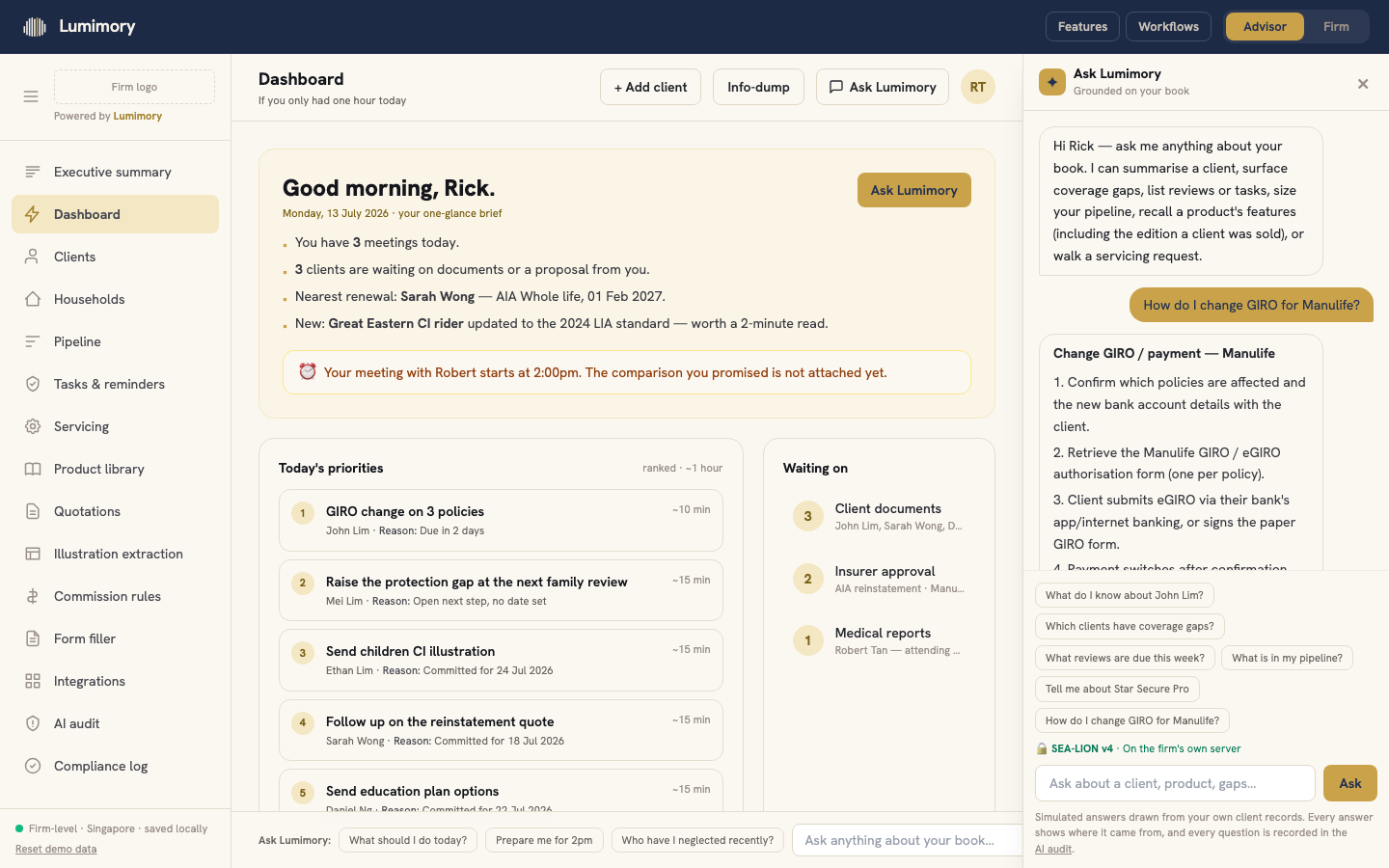
Lumimory

An AI system we built, and still run.

An adviser asks a question and the answer comes back with the carrier steps, the form, and the source it was drawn from — answered on the firm’s own server. Agile Labs designed it, built it and operates it.

  • Evaluation
  • Guardrails
  • Logging
  • Cost control
  • Path to production
Read the Lumimory story
The Ask Lumimory panel: a question, the carrier steps in reply, and the source each step came from

What we build

Assistants

Answer questions from company knowledge, with every answer citing its source. When the material has no answer, they say so instead of inventing one.

Agents

Carry out tasks in real systems. Every action is recorded and reversible, and anything that spends money or sends a message stops for a person to approve.

Predictive models

Score, forecast and flag from operational data. Always measured against the simplest method that could work, so the gain is real and visible.

Measurement never stops at launch

The cases used to test the system before launch keep running as the system changes. When a real failure occurs, it is added as a new test case so the same problem can be caught if it happens again.

We also test the system against alternative models each quarter. This shows what would change if the business needed to switch providers, rather than finding out only when the switch becomes necessary.

Model, data and running cost

An AI system usually runs on a model that someone else owns. The provider can change that model underneath the system, the data goes out to be processed, and every use is billed. All three are settled before the system goes live.

The modelA pilot is often written for one provider, and moving to another means a rewrite. The model is chosen by its score on the graded cases from the workshop, and the system is built so that model can be swapped for another.
The dataIn a typical pilot, data goes to the model provider on whatever terms the developer accepted at sign-up. Before the first request is sent, the provider, the agreement and the region are written down, and nothing trains on the company’s data without a separate written decision naming what and where.
The running costA pilot costs little because few people use it, and the first real bill arrives after launch. Before launch, the cost of a month at real volume is measured per team, and a spending limit is set from that figure.

Learn how we build

Evaluation and error rates

How correct is defined, how it is measured on real cases, and why one accuracy number is never enough.

Learn more

Retrieval over company data

How an assistant finds the right passage in a large body of documents, and why the index inherits every old permission mistake.

When a person signs off

Which actions an agent may take alone, which stop for approval, and how the review work is kept manageable.

Model choice and switching cost

How the model behind a system is chosen, and how the cost of changing it is measured instead of guessed.

Where your data goes

Which provider, under which agreement, in which region — fixed in writing before the first call is made.

Running costs at scale

What a working system costs per month at real volume, measured per team, with limits that hold.

Featured story

CircularOne performance dashboard

ecoSPIRITS

CircularOne runs ecoSPIRITS’ closed-loop operation worldwide. The AI in it earns its place: predictive models watch hardware usage and catch faults early, and sensor readings, hardware events and partner activity are stored together in raw form so the data can be analysed later for different purposes.

Read the ecoSPIRITS story

If the software matters,
talk to us.

Build AI that works