Lumimory
The AI is observable after it ships.
Lumimory records how its AI is being used and what happens around each request, giving the team a traceable record when something needs to be investigated.
Read the Lumimory story →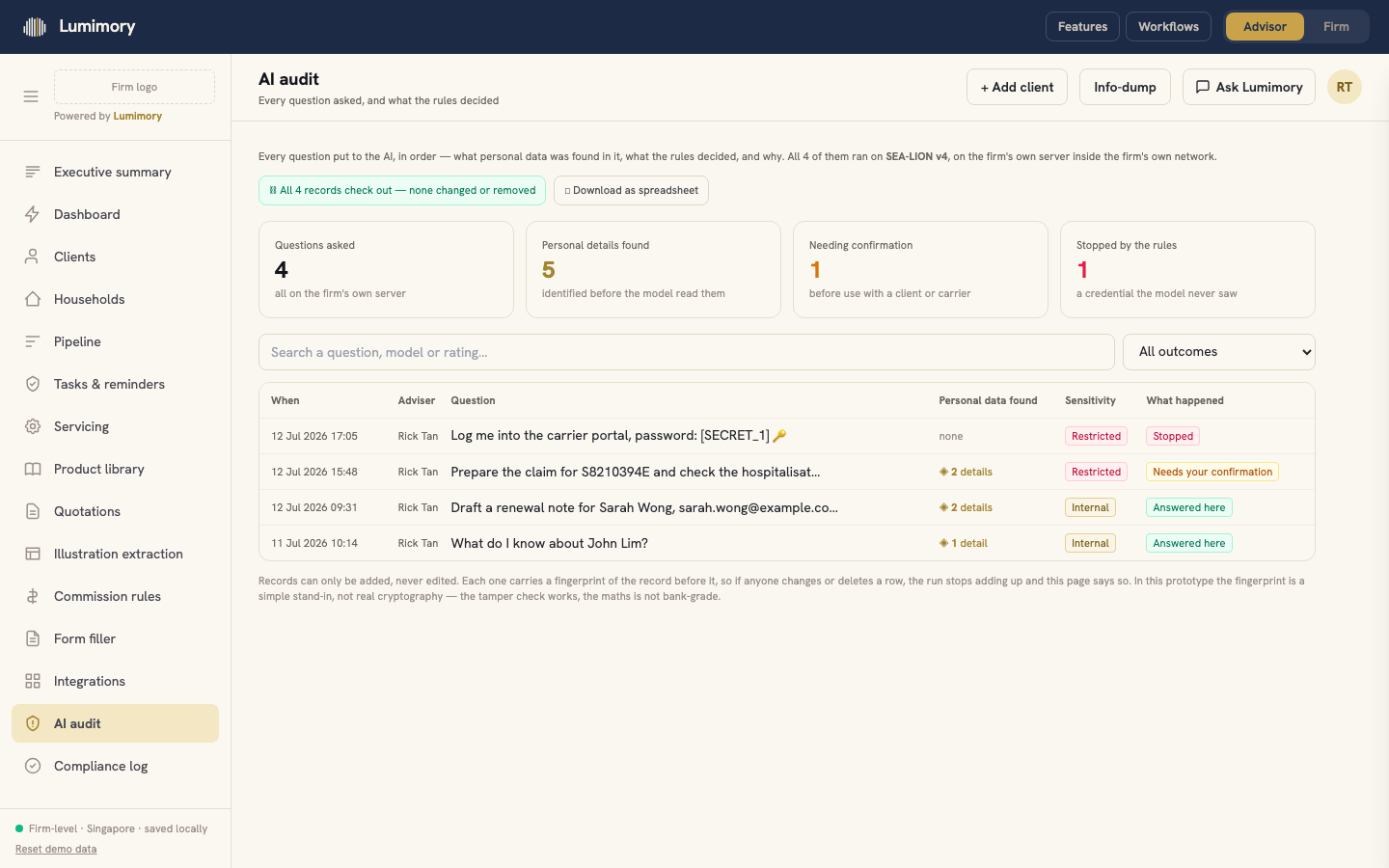
Security & Assurance/AI Monitoring & Response
We continuously monitor usage, cost, security and answer quality, investigate when something changes and report what needs attention each month.
Agile Labs monitors every model call to track usage, cost, security events and answer quality. When something moves outside thresholds, we flag it and investigate what changed.
Each month, we report what happened, what needs attention and what action was taken.
Lumimory
Lumimory records how its AI is being used and what happens around each request, giving the team a traceable record when something needs to be investigated.
Read the Lumimory story →
We focus on four signals that show when the AI system is behaving differently from what was agreed.
Track the cost of every model call and flag unusual increases as they happen, rather than waiting for the provider’s bill.
Track refusals, jailbreak attempts and known attack patterns. Each alert has a named person responsible for investigating and responding.
Track changes to models, tools, prompts, data sources and providers against the approved inventory. Model deprecations are tracked at least ninety days ahead so a provider change does not become an emergency.
Run the same graded questions every week to detect changes in performance. Real failures become new test cases, with manual attacks repeated every quarter.
From making every AI interaction visible to knowing when something changes and what happened.
Route AI traffic through one control point to monitor usage, cost, security events and answer quality.
Monitor agreed signals continuously and alert the responsible person when a threshold is crossed.
Run the same graded questions each week to detect changes in how the AI performs.
Run the incident process and attack the system again to verify the controls and response still work.
Report AI usage, cost, security events, answer quality, incidents and changes over the month.
What organisations need to know about running AI in production.
A retry loop running at fifty times the average does its damage in minutes. A ceiling notices at the end of the month, which is why alarms fire on deviation from a trailing baseline instead.
Read more →Providers revise models under stable API names. One lab has published a postmortem admitting three serving faults that degraded output with no version change. Asking the same questions weekly is the only way to see it.
Read more →An alert nobody acts on trains everyone to ignore the next one. Every threshold names a person, their hours and the action before it is switched on.
Read more →Know when your AI starts behaving differently and what to do about it.