Engineering/Application Development
AI has made software faster to produce. Agile Labs makes sure that speed does not come at the expense of security, reliability and maintainability.
A growing share of new code is written by AI. Microsoft puts its own figure at 20 to 30 percent; Gartner expects 40 percent of new enterprise software to be built this way by 2028. What that code is like once it ships has now been measured four times.
Lumimory
AI has made software faster to produce. We combine that speed with the security, testing and engineering judgement needed to turn code into production software.
See how Lumimory is engineered →AI makes code faster to produce. We use that shift to put more engineering effort into what surrounds it: testing more paths, reviewing every change and improving the code while it is still cheap to change.
Where the hours go once code takes less time to write: the paths that were previously left to manual checks, and the edge cases a deadline used to cut.
Review used to be rationed by how long it took. What changes when a second engineer reads every change the week it is written.
Most codebases decay because tidying never justifies the hours. What gets fixed when it does, and what that is worth in year three.
Each stage settles something before the next one starts — what is being built, whether it works, and whether it can be run.
We turn requirements into a working
prototype to align early.
Click through. Review together.
Close the gaps. Get aligned.
AI assists our engineers across
the entire development lifecycle.
Short sprints. Working software.
Feedback drives what we build next.
Continuously delivered, secure
and enterprise-grade.
The cost of a security mistake is set by decisions taken long before it happens. Three of them are made during the build.
Access rules written into the data model rather than added over it. Retrofitting them later is the change nobody budgets for.
Dependency scanning, secret detection, static analysis and a second engineer. Each catches something the others miss, and a failure stops the merge rather than raising a ticket.
Secrets are held outside the code, scoped to one job and rotated on a schedule, so an exposed key does not open production data.
The software will change after launch. We build it so new features can be added, dependencies updated and security fixes made without every change becoming a risky project.
New features should not require engineers to understand or rewrite half the system.
Dependencies, frameworks and infrastructure will change. The software needs to move with them.
Tests and clear boundaries let engineers change one part without guessing what else might break.
The code, documentation and operating knowledge stay with the system, not only with the people who built it.
Agile Labs engineers for a lower cost of change and for continuity, so the software keeps moving with the business that runs on it.
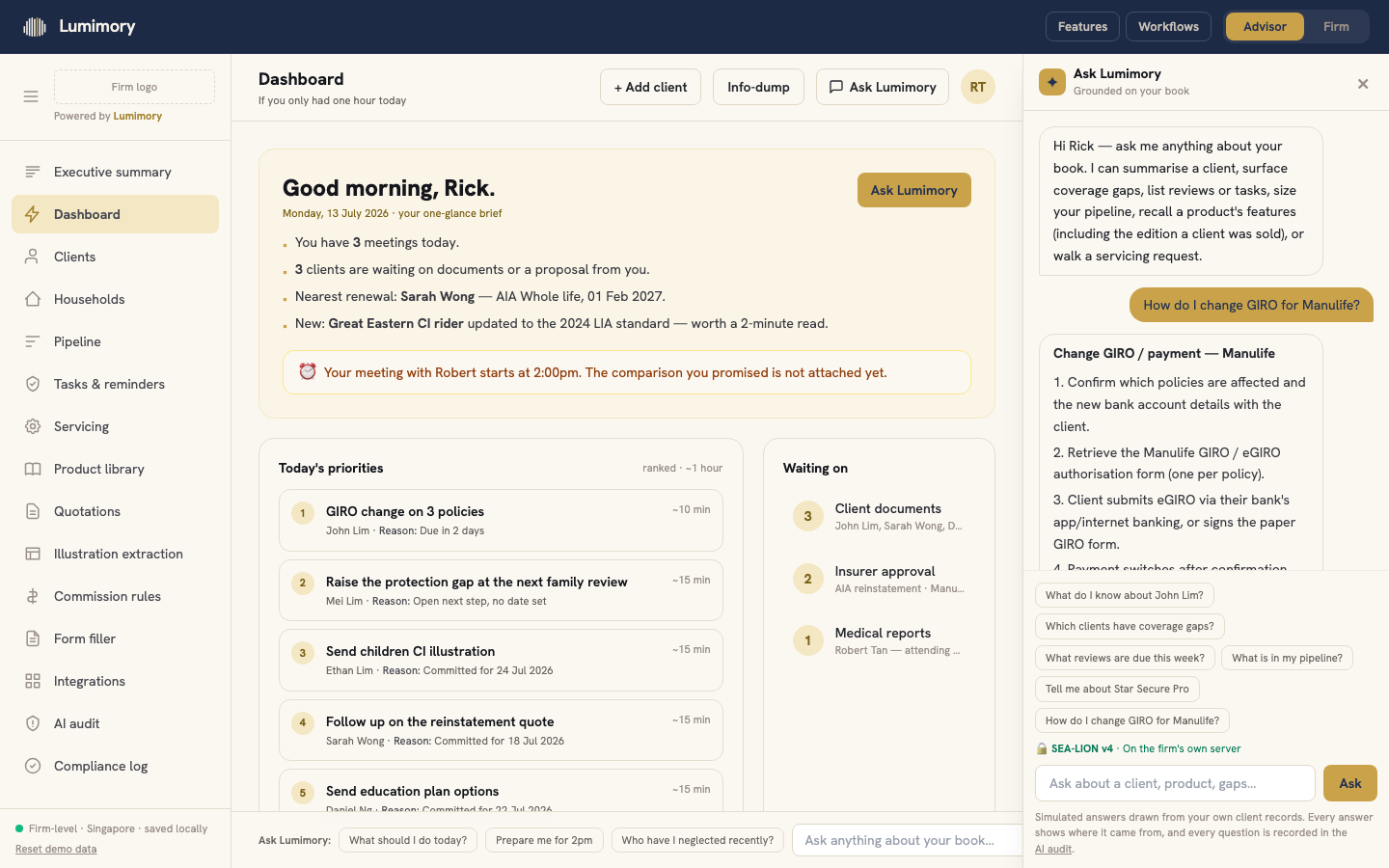
An organisational-memory product for insurance and advisory businesses, built and operated by Agile Labs. An adviser asks a question and gets the carrier steps, the form and the source it came from, answered on the firm’s own server. Pre-launch, with Founding Design Partner pilots open.
Read the Lumimory story →