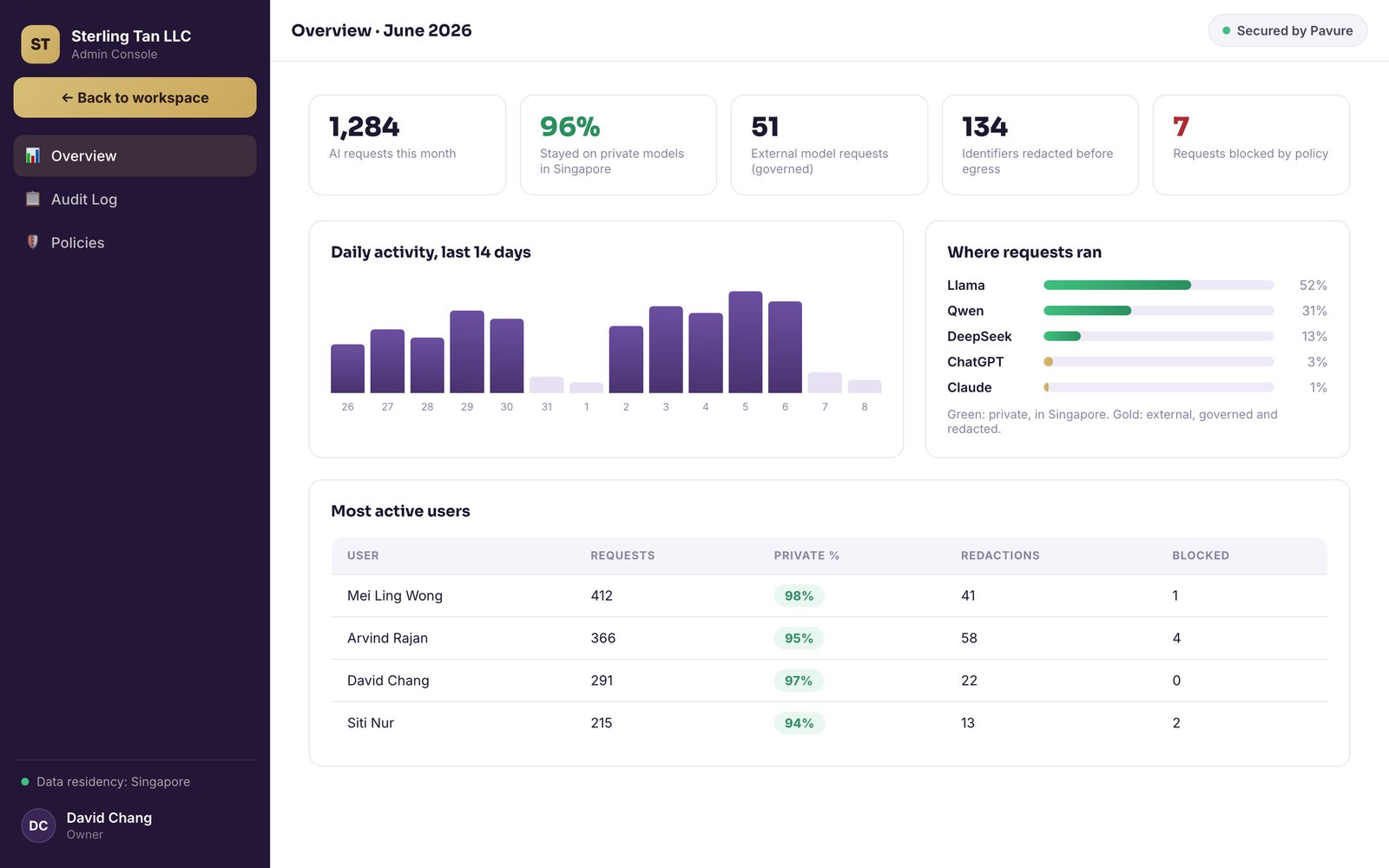
Pavure is a private AI workspace for organisations that need to use AI while keeping control of their data, their model access and how AI systems reach company information. As it moved towards enterprise customers, the question stopped being whether the software worked and became whether it could survive an enterprise security review. Agile Labs ran an Enterprise Readiness Assessment, then implemented and verified the controls its findings called for.
Pavure connects users, company data and external AI models. That combination carries a different risk profile from conventional software, and an enterprise buyer needs specific assurances before approving it: that users reach only what they are authorised to see, that model providers can be controlled, that sensitive information is handled appropriately, and that AI agents cannot take actions beyond their intended permissions.
The conventional risks still applied underneath. Dependencies, known vulnerabilities, licences, deployment practice, recovery, logging, testing and maintainability are all examined during an enterprise review, and any of them can hold up an approval.
So the question was broader than a vulnerability scan. Could the product show, with evidence, that its software and AI controls were ready for enterprise use?
We reviewed the application, its architecture, infrastructure, dependencies, integrations and operating practices. Automated dependency and vulnerability scans set the technical baseline. Manual testing covered what scanners cannot determine reliably: access control, tenant isolation, data handling and permissions.
Each finding carried its severity, the evidence behind it, the consequence if it were left, and the remediation required. The result was a prioritised route from the product as it stood to a product that could go through an enterprise technical and security review.
The assessment then became the input to the engineering work, and the findings were implemented rather than filed.
Model calls pass through a gateway that determines which models can be used, by whom, and under what conditions. Identity, budgets, guardrails and logging sit at that layer, which gives AI activity a single control point.
The data and systems available to AI were reduced to what the work requires. Untrusted content, private information and outbound access were separated, so one compromised component cannot expose everything the AI can reach.
Tools hold only the permissions their task needs. Shared credentials were removed where appropriate, and consequential actions require explicit human approval.
Logging and evidence collection were built into the controls, so Pavure can show what was allowed, blocked or changed rather than stating that safeguards exist.
The engagement ran as one path from identifying risk to resolving it, rather than as a report followed by a separate project.
Architecture, dependencies and operating practice, with manual testing where scanners cannot answer.
Findings ranked by severity and consequence, separating what must be fixed first from what can follow.
Gateway, permissions, agent constraints and logging, implemented in the product itself.
The same tests that produced the findings, run again against the remediated system, with the result recorded.
Pavure came out of the engagement with a clearer security architecture, controlled model access, contained permissions, auditable AI activity, and evidence that the implemented controls had been tested. The findings from the assessment were verified as addressed rather than assumed to be.
What the product holds now is the thing an enterprise review actually asks for: not a claim that controls exist, but a record showing what they did.
Enterprise Readiness Assessment → Secure AI Engineering →Build better software, with zero surprises